Welcome Aboard
WE’RE EXCITED TO HAVE YOU JOIN US TODAY!
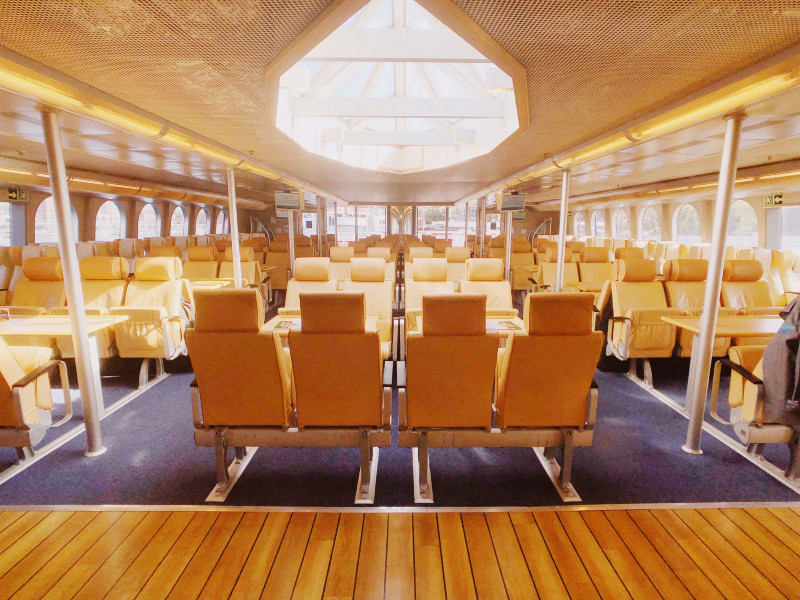
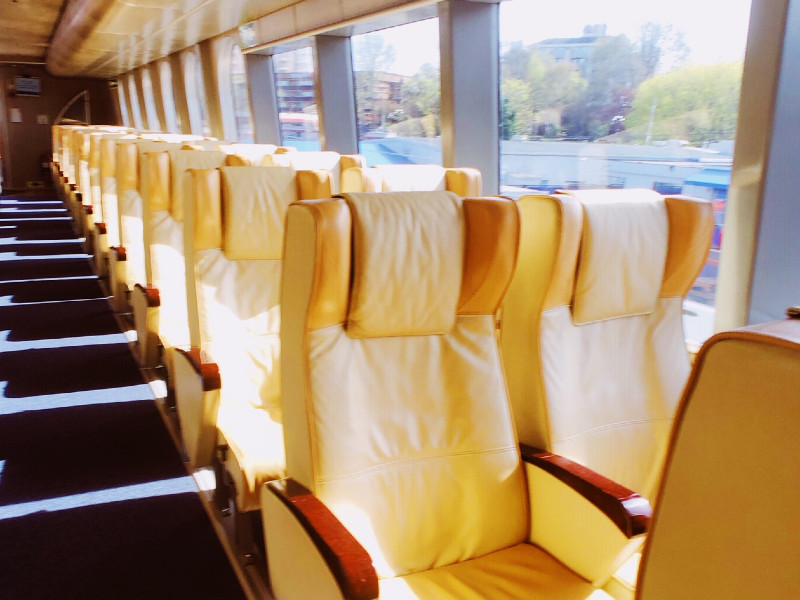
We’re excited to have you join us today! Please sit back and allow our captain, crew, and expert naturalist guide you on an excursion through some of the most picturesque waterways in the world. Cruising aboard the Emerald Clipper, you will have the chance to view magnificent scenery in the region. To ensure an inspiring, comfortable, and memorable trip, please follow all safety measures as directed by the crew.
We’ll be cruising through waters with many different kinds of vessel traffic. Other vessels, wind, and currents can cause waves that may cause our boat to rock without warning, so please watch your step while moving about the cabin and outer decks, use the handrails while on the stairways, keep personal items out of the aisles, avoid smoking, and make sure children are attended at all times.
If you have any questions or need assistance, please bring it to our attention. Most importantly, have fun and enjoy the adventure!
MAKING A DIFFERENCE
WITH CONSERVATION
For more than 20 years, FRS Clipper has provided the only whale and sealife viewing tour direct from downtown Seattle. Following both Pacific Whale Watch Association Guidelines and state and federal regulations, FRS Clipper ensures guests observe whales and sealife at appropriate distances in a non-disruptive manner.
As a member of PWWA, FRS Clipper is part of a fleet of whale watching vessels that serve a sentinel role for whales and sealife by modeling appropriate viewing distances and speed for surrounding recreational boaters. Each FRS Clipper whale watching tour also features scientifically educated, expert naturalists who guide and educate passengers on whale and sealife behavior in the species’ natural environment. Data is collected in real time and reported to whale research and other various organizations to accurately track and monitor the presence and behavior of local whale populations and their surrounding environments.
The Emerald Clipper is a dedicated steward for the Salish Sea. We do not observe critically endangered populations, as the long-term health and safety of our local species is our utmost priority.
NAVIGATING OUR WATERS
Sailors have moved from observing the sun and stars to state-of-the-art electronic navigation. While keeping a constant eye out the window is one of the best tools, modern electronics provide a wealth of information to keep mariners safe and on course.
RADAR (RADIO DETECTION AND RANGING)
This instrument, the most commonly used on a ship, detects surrounding objects using radio waves. Similar to an echo, a radar transmits a wave, and the time it takes for this echo to bounce back is used to calculate the distance of an object.
AIS (AUTOMATIC IDENTIFICATION SYSTEM)
AIS uses a built-in GPS receiver to continuously transmit a vessel’s identity, position, and speed. This allows not only shore stations to get crucial navigational data, but also broadcasts information to all other AIS-equipped vessels in range, managing maritime traffic and reducing the hazards of navigation.
ELECTRONIC CHARTS
In 2019, the National Oceanic and Atmospheric Administration (NOAA) announced that by 2025, they will no longer produce and update paper charts for marine navigation. Unlike paper charts, ENCs can overlay radar images and AIS targets and be easily updated. They are used on large ships planning voyages around the world or fishermen looking to get close to the rocky shore.
COMMUNICATIONS – BRIDGE TO BRIDGE VESSEL TRAFFIC SYSTEM
Another critical tool for safe navigation is the marine radio. Marine VHF radios allow navigators to contact each other, arrange a safe crossing situation, and remove any doubt of the other’s intention. In the Salish Sea, all commercial marine traffic is monitored and coordinated by a Vessel Traffic System (VTS). These are the “air traffic controllers” on the water.
About Our Region
THE SALISH SEA
The Salish Sea is a body of water spanning the border between British Columbia and the U.S. state of Washington. It covers 42,000 sq miles from Olympia, Washington, to Campbell River in British Columbia. The Salish Sea is the conglomeration of all the waters of the Strait of Juan de Fuca, the Strait of Georgia, the San Juan Islands, and Puget Sound.
PUGET SOUND
Puget Sound is a maze of waterways extending 90 miles south from Admiralty Inlet to Olympia, Washington. Its glacially carved channels divide the Olympic and the Cascade mountain ranges.
Working Together
To Spot Wildlife
FRS Clipper is proud to be a Pacific Whale Watching Association (PWWA) member, committed to education, conservation, and responsible wildlife viewing. Members of the PWWA work together across Washington state and British Columbia to record whale sightings and encourage all vessels to follow appropriate wildlife viewing practices.
Whales may be present anywhere in the Salish Sea. They travel continuously, and while some species may have areas they visit more often than others, there is no way to predict which whales will be seen or where we will see them on any given day. PWWA member vessels are always on the alert for whale sightings. When one vessel spots a whale, the location is relayed to the rest of the fleet via a secure network. In addition to reports from the PWWA fleet, our crew monitors reports from shore-based whale watchers and constantly scans the water for wildlife.
During your cruise aboard the Emerald Clipper, you are invited to join your crew in keeping your eyes on the water, watching for any signs of wildlife in the area. Things to watch for include the “blow” of whales surfacing to breathe, tail flukes of whales making a deep dive, or dorsal fins (the fins on the backs of most whale species) rising above the surface of the water. If you feel like you’ve seen anything like these, or something else you feel like we should be aware of, please let a crew member know so that all of us can observe and check it out with you!
Wildlife We May See
Orca Whales
Orcas are highly intelligent and social animals, often traveling in family groups. Their fierce predatory style won them the nickname of “Killer Whale” with their adept abilities to coordinate and succeed in taking down prey. Found throughout the world’s oceans, orca populations are traditionally broken down by groups called “ecotypes.” Here in the Salish Sea, we have two populations that are so different that, as of the summer of 2024, they are officially separate subspecies! These two subspecies are known as Biggs and Residents.
Orcas are the largest member of the dolphin family. Here, male orcas can reach up to nearly 29 feet in length and weigh eight tons, with dorsal fins growing as high as 6 feet. Females are smaller, growing to 24 feet and weighing around six tons, with curved, 2-3 foot dorsal fins. This difference in dorsal size makes it possible to tell the mature sexes apart while viewing them from the boat!
SALMON-EATING “RESIDENT” ORCAS
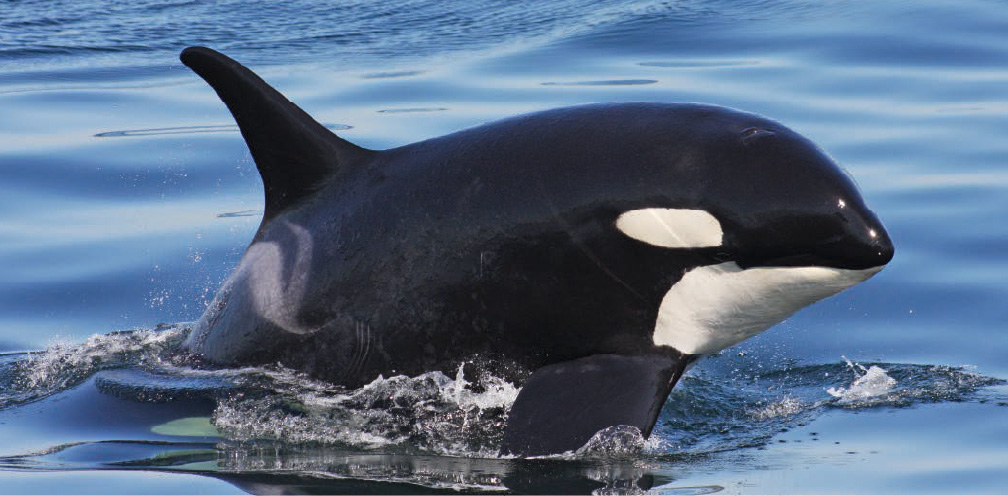
Salmon-eating orcas, also known as “resident” orcas, have smaller and more defined traveling ranges, historically spending months in a specific area. They travel in extended family groups that can exceed 20+ whales. Typically, resident orcas spend their entire lives traveling with their mothers. They interact, socialize, and breed with other members of the resident pods but do not interact with the mammal-eating population. Adult salmon-eating orca in the Salish Sea need around 200 pounds of food daily and rely on Chinook salmon for more than 75% of their diet. Resident orcas occur in various places along the Pacific Northwest coast, with a genetically distinct population who spend part of their time in the waters of the Salish Sea, known as the Southern Resident Killer Whales or SRKW.
This community is comprised of three extended families: J, K, and L Pods, and are one of the best-studied whale populations in the world. Unfortunately, this population is critically endangered, with fewer than 75 individuals remaining. Historically, the Southern Residents spent 4-7 months of the year in the Salish Sea. However, numerous environmental factors have caused a sharp decline in Chinook salmon populations, and now these orca can no longer find sufficient food. As a result, Southern Residents must now travel farther out and for longer periods in an effort to survive. In addition, nearly one-third of the population was forcibly removed from the Salish Sea during the 1960s and 1970s for entertainment purposes by marine parks. Today, due to humanity’s notorious arrogance to their needs, the population is listed under the Federal Endangered Species Act.
MAMMAL-EATING BIGGS ORCAS
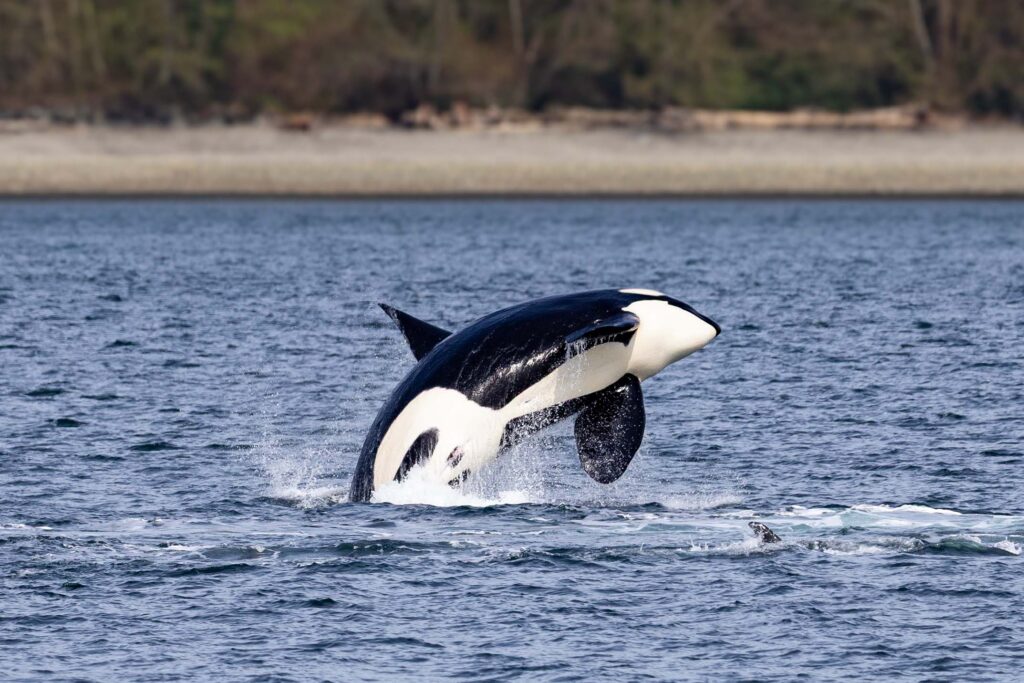
Mammal-eating orcas, also called Bigg’s or “transient” orcas, travel the coast between Alaska and California in small pods, usually consisting of a mother and her offspring. Their primary prey in the Salish Sea are harbor porpoises and harbor seals, although sea lions and minkes are sometimes on the menu.
Bigg’s mammalian diets are a key factor in their way of life, defining their culture, travel patterns, and even vocalizations. Unlike the Residents, Bigg’s populations are currently in a stable growth pattern, having an estimated 450+ individuals with a steady annual growth rate. This stable growth can be partially attributed to their diet, with their marine mammal food resources also having reliable and healthful population statuses.
HELP US SPOT ORCAS BY KEEPING YOUR EYES OPEN FOR COMMON BEHAVIORS!
Breach
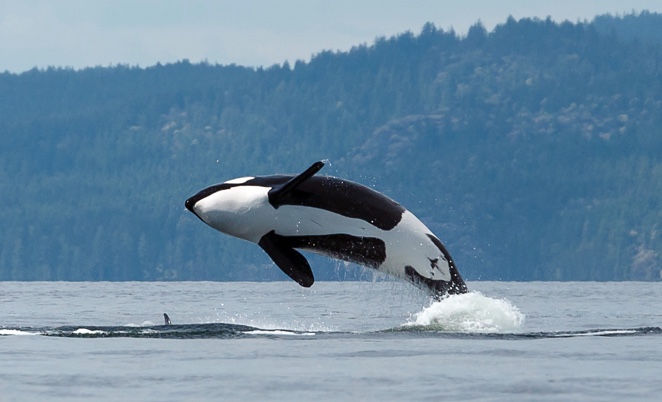
When two-thirds or more of the body breaks the surface of the water, it’s called a breach. Typically followed by a large splash as they crash back down to the water below! Breaches can be for several things – communication, parasite removal, or just play!
Tail Lobbing
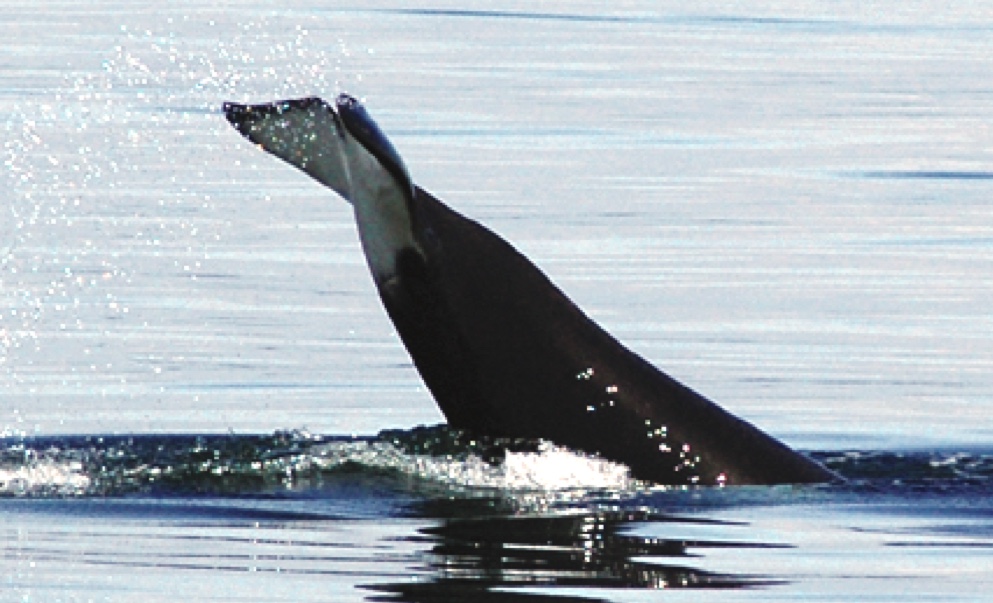
Tail flukes slapped on the water’s surface is called tail lobbing. This is oftentimes a communication tactic. Perhaps there is food to be shared, or a family member wants others to return to them.
Spy Hopping
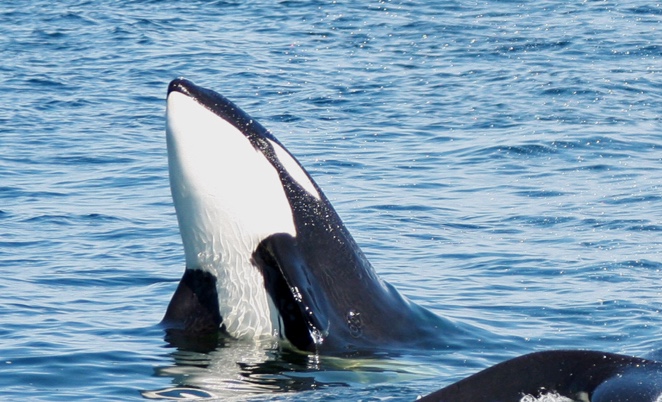
Spyhopping is when a whale raises their head and upper third of their body above the water, typically hovering for a few moments. This is often for the individual to get a good look above the water’s surface, observing the area around them.
HAVE A QUESTION OR WANT TO KNOW MORE? ASK OUR ONBOARD NATURALIST!
Wildlife We May See
Baleen Whales
Baleen whales have no teeth. Instead, they have something called “baleen.” Baleen plates are made of keratin, the same material as our hair and fingernails, and grow from the upper jaw of the whale’s mouth. From the outside, the baleen plates may have an appearance of a long, skinny comb, but on the interior, they are fringed into fine bristles. These whales use these plates to trap and strain small prey out of the water for food.
GRAY WHALES
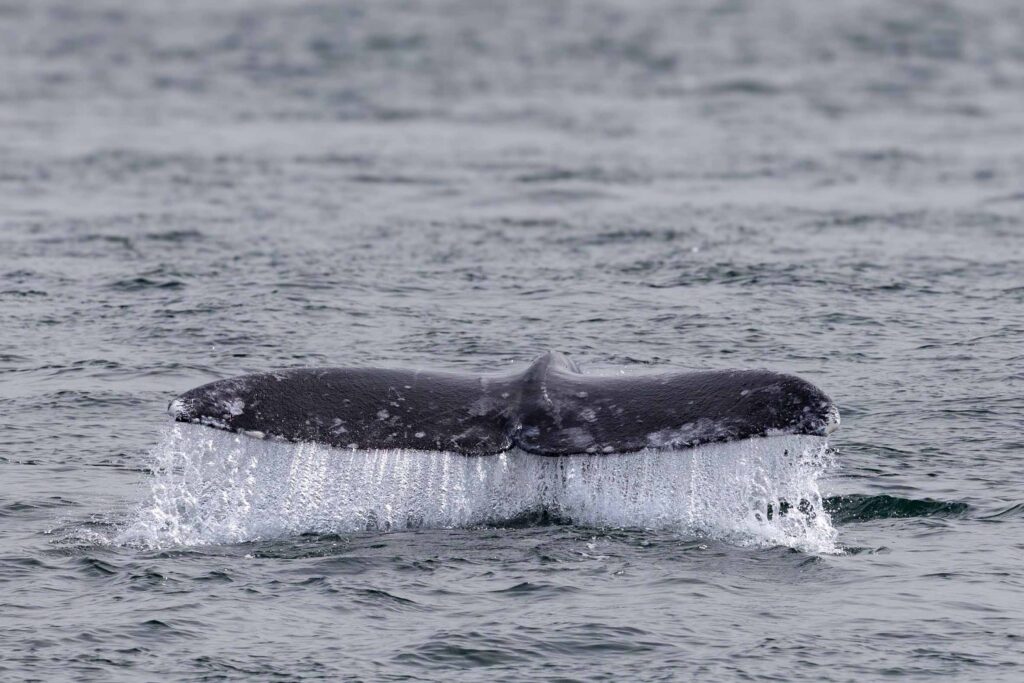
Pacific Gray whales have the longest migration of any mammal on the planet, traveling ten to twelve thousand miles annually. They spend their summers feeding in the waters just south of the Arctic Circle and their winter breeding season in the warm waters near Baja. Since 1990, around two dozen of these whales have been observed diverting their route and taking a “pit stop” to the Pacific Northwest during their Northern migration. These individuals are fondly referred to as the “Sounders.”
The average adult gray whale reaches 50 feet and weighs up to 35 tons. They have robust bodies that are mottled gray, marked with barnacles and yellow patches of Cyamidae, a crustacean that lives on some whale species. In the Salish Sea, gray whales feed on the abundant ghost shrimp in the sandy sediments close to shore, filtering mouthfuls of mud and sand through their baleen plates.
How to spot: Look for a mottled gray back and a tall, heart-shaped blow.
HUMPBACK WHALES
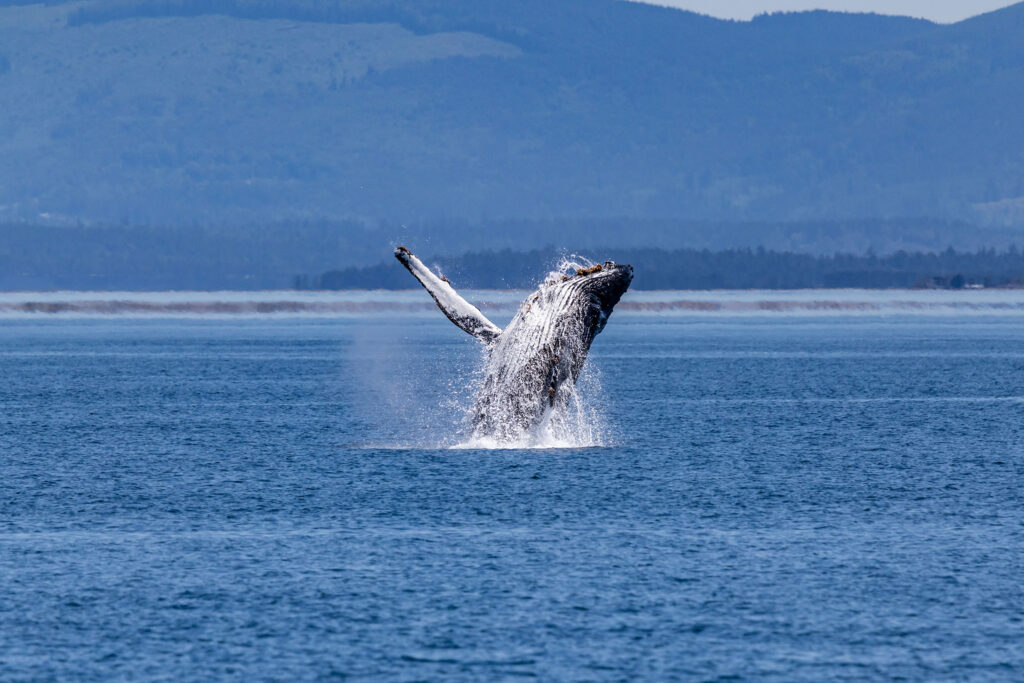
Once an extremely rare sight in the Salish Sea, humpback whales are becoming frequent visitors here as their Pacific populations recover from the days of commercial whaling. Humpbacks are migratory, with our Salish-feeding population spending their summers along the Pacific Northwest coast and then returning to their winter breeding areas either in Hawaii or off the coast of Mexico and Costa Rica.
They can reach up to 60 feet in length, weigh up to 33 tons, and have the longest pectoral fins of any whales, which are usually much lighter in color than the rest of their bodies. They have dark gray backs with a small dorsal fin perched atop a rounded hump, for which they are named.
How to spot: Watch for a tall, cylindrical blow possibly rising more than 20 feet into the air, followed by a small, low dorsal fin and broad tail flukes, each marked with unique underside patterns.
MINKE WHALES
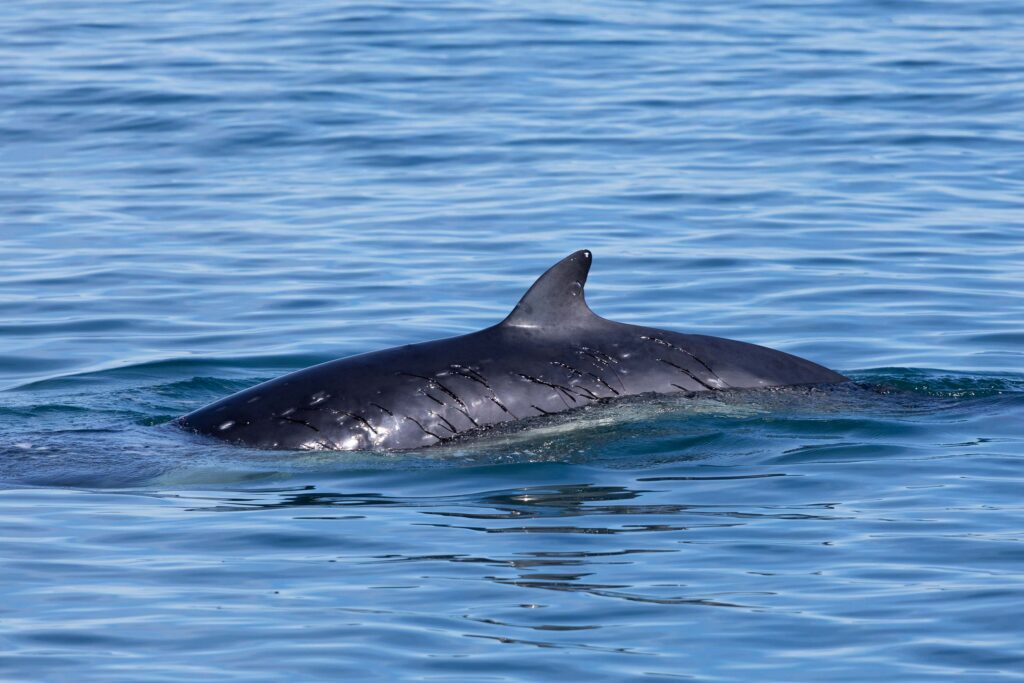
Minke whales are one of the smallest baleen whales, capable of reaching speeds up to 25mph! Also known as a ‘lesser finback,’ minkes are usually solitary, but may be seen in groups in areas where food is abundant. They are dark gray to black, have a rather sickled dorsal, and often have a pale chevron behind their heads.
Adults grow to an average size of 30 feet and weigh between five and ten tons. Like other baleen whale species, female whales tend to be larger than their male counterparts.
How to spot: You gotta be fast! Listen for a breath, and if you’re lucky, you’ll spot a low, bushy blow at the waterline. A long streamline back is followed by a small, very sickle-shaped dorsal fin.
Wildlife We May See
Marine Life
HARBOR PORPOISE
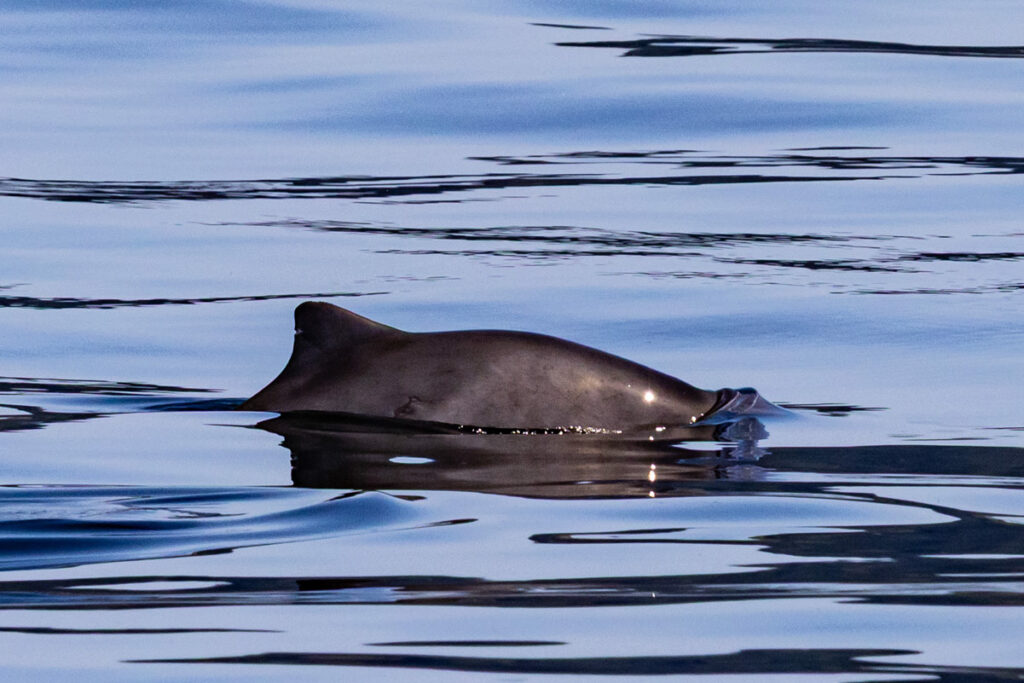
These relatively shy animals are the second smallest cetacean, rarely growing more than five feet in length. Their small size makes them challenging to spot in choppy seas, but they are easily visible when surfacing in calm waters. Unlike populations in the rest of the Northern Hemisphere, those who live in the Salish Sea remain here year-round instead of migrating. They may be seen traveling alone or in small groups of around 2-5, typically.
How to spot: Look for short dark gray backs and short triangular dorsal fins breaking the surface of the water.
HARBOR SEAL
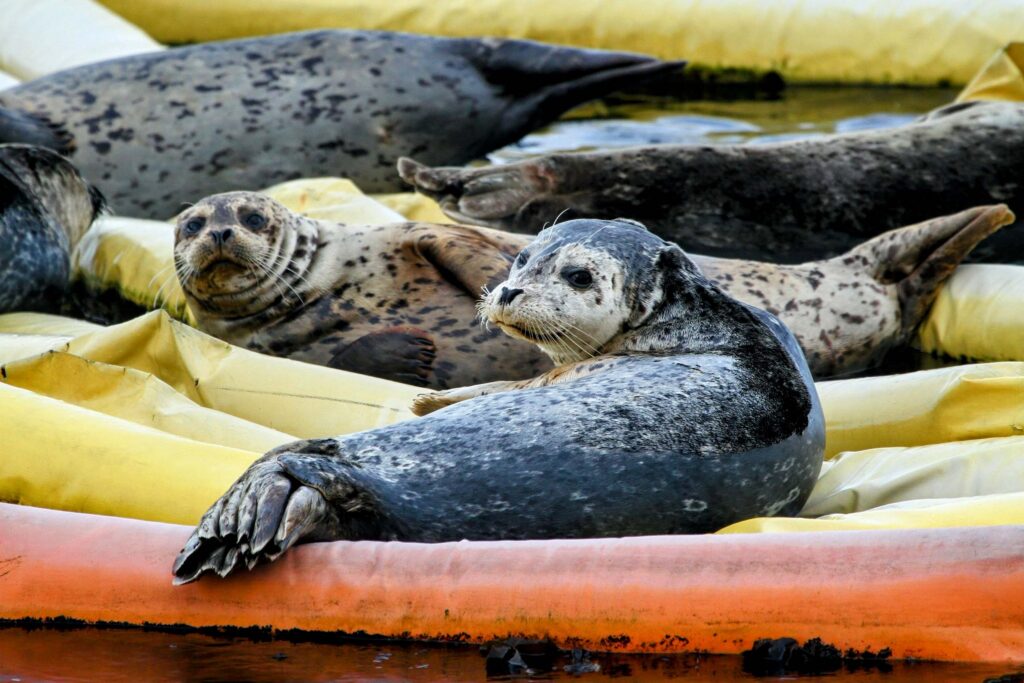
Harbor seals are the most abundant marine mammal in our area and can be found in any of our Salish Sea waterways.
Their distinct torpedo shape assists in their hydrodynamic swimming and is a result of a thick layer of blubber that insulates them from cool waters. Their spotted fur varies from nearly white to almost black, with any color or pattern in between. Adults average six feet in length and can weigh up to 350 pounds.
These seals are incredible hunters with the capability to dive up to 600 feet deep and stay submerged for over 25 minutes to forage for foods such as fish, mollusks, and crustaceans.
How to spot: Scan the water’s surface for a smooth, bowling-ball–shaped head gliding by, or look along docks and low shorelines where they frequently haul out to bask and doze.
STELLER SEA LION
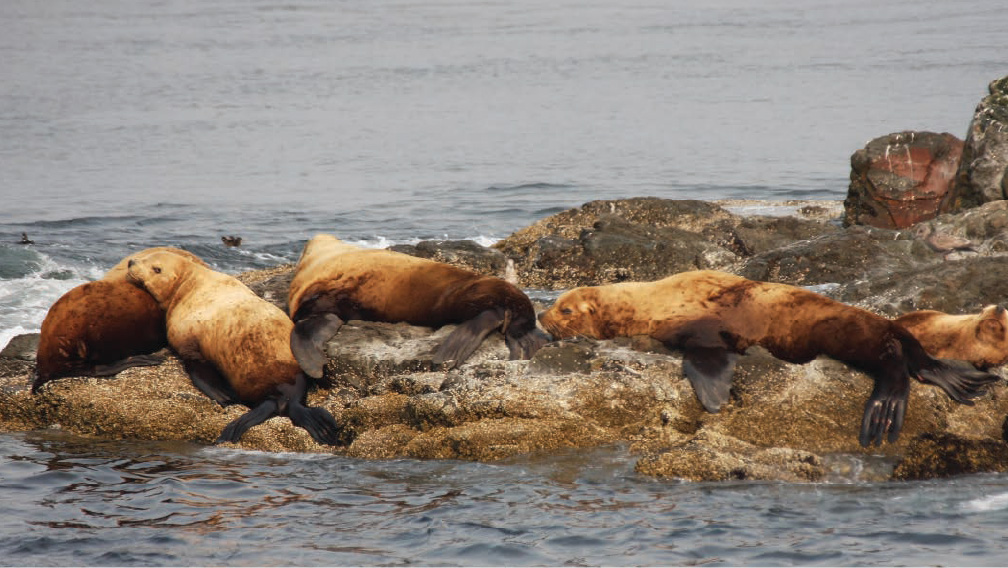
The Steller sea lion is the largest of all sea lion species. Adult males can reach lengths of up to 11 feet and weigh more than 2,000 pounds, while females typically grow to nearly eight feet and weigh around 800 pounds. As males mature, they develop a distinctive thickened neck and mane. Steller sea lions are opportunistic feeders and are capable of diving to depths exceeding 1,000 feet.
Sea lions differ from their seal relatives in several notable ways. Most visibly, they possess external ear flaps, known as pinnae, on either side of the head. They also have elongated necks and long, powerful front flippers, which they use both for propulsion in the water and for supporting their upper bodies on land. Unlike true seals, sea lions can rotate their hind flippers forward beneath their bodies, allowing them to move on land with a four-limbed, almost quadrupedal gait.
How to spot: Steller sea lions are most often seen hauled out on navigational buoys or rocky shorelines. Look for very large, thick-bodied animals with light brown to blond fur.
CALIFORNIA SEA LION
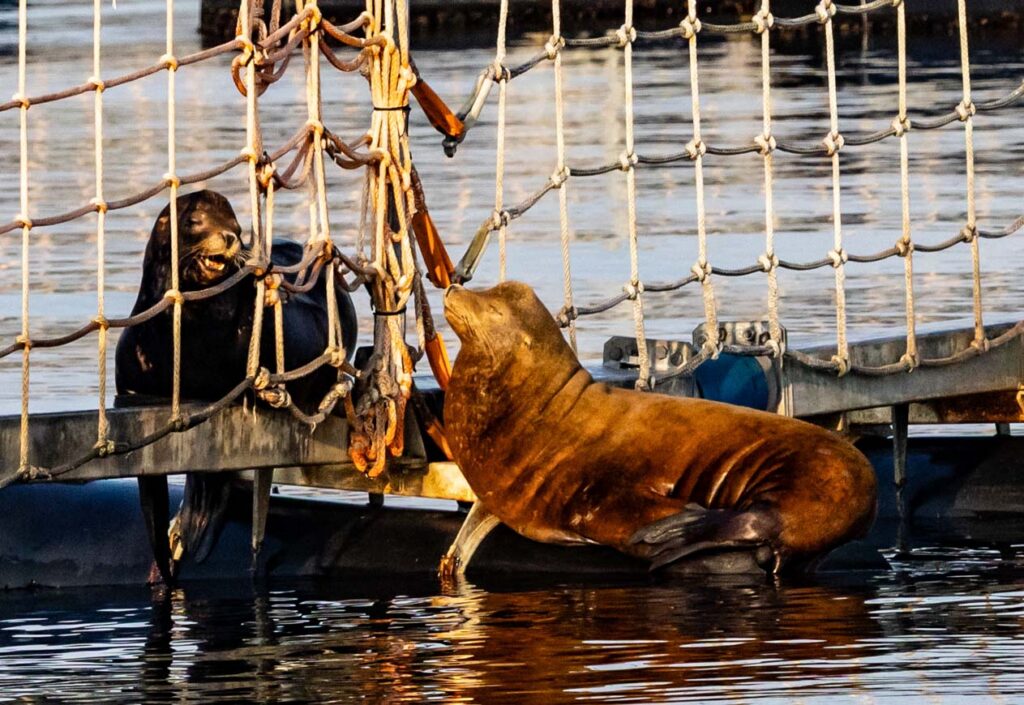
While it is possible to see both, it is almost exclusively male California sea lions who are seen here in the Salish Sea. Most females remain at their breeding grounds in California year-round, while the males migrate north. They stay from fall through late spring, feeding on fish and preparing for the summer breeding season.
California sea lions are dark brown and appear black when in the water. At maturity, the males also develop a prominent raised forehead called a sagittal crest. Smaller than Steller’s, adult males can reach lengths of eight feet and weigh over 1,000 pounds, while females typically measure six feet in length and can weigh up to 250 pounds.
How to spot: Found in several of the same locations as Steller’s, look for sleeker, darker brown bodies, often appearing chocolate-colored when dry and nearly black when wet. Males will possess that prominent forehead bump.
Salmon
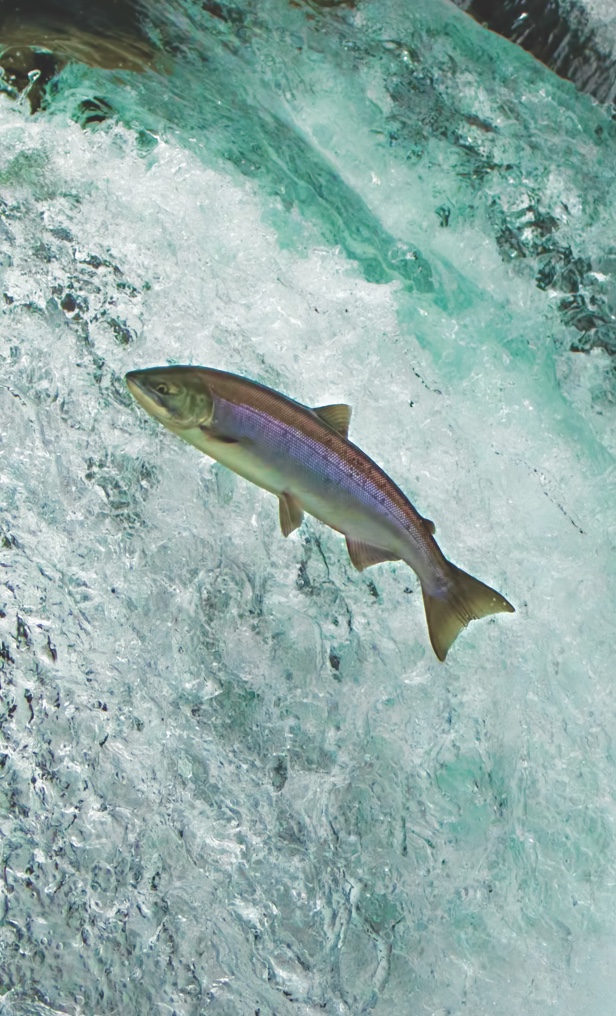
Salmon are anadromous fish, meaning they are born in fresh water, migrate to salt water for their adult lives, and at the end of their lifecycle return back to their natal fresh waters to spawn. After the returning adults reproduce, they die, their bodies providing vital nourishment back to the river system. On average, a female salmon will lay approximately 4,000 eggs, but statistically, only two will survive to return to their spawning grounds. The importance of salmon in the Pacific Northwest ecosystem cannot be overstated. Over 130 species rely on salmon for all or part of their diet, including the endangered Southern Resident Orcas, who rely on Chinook salmon for 75% or more of their diet.
Jellyfish
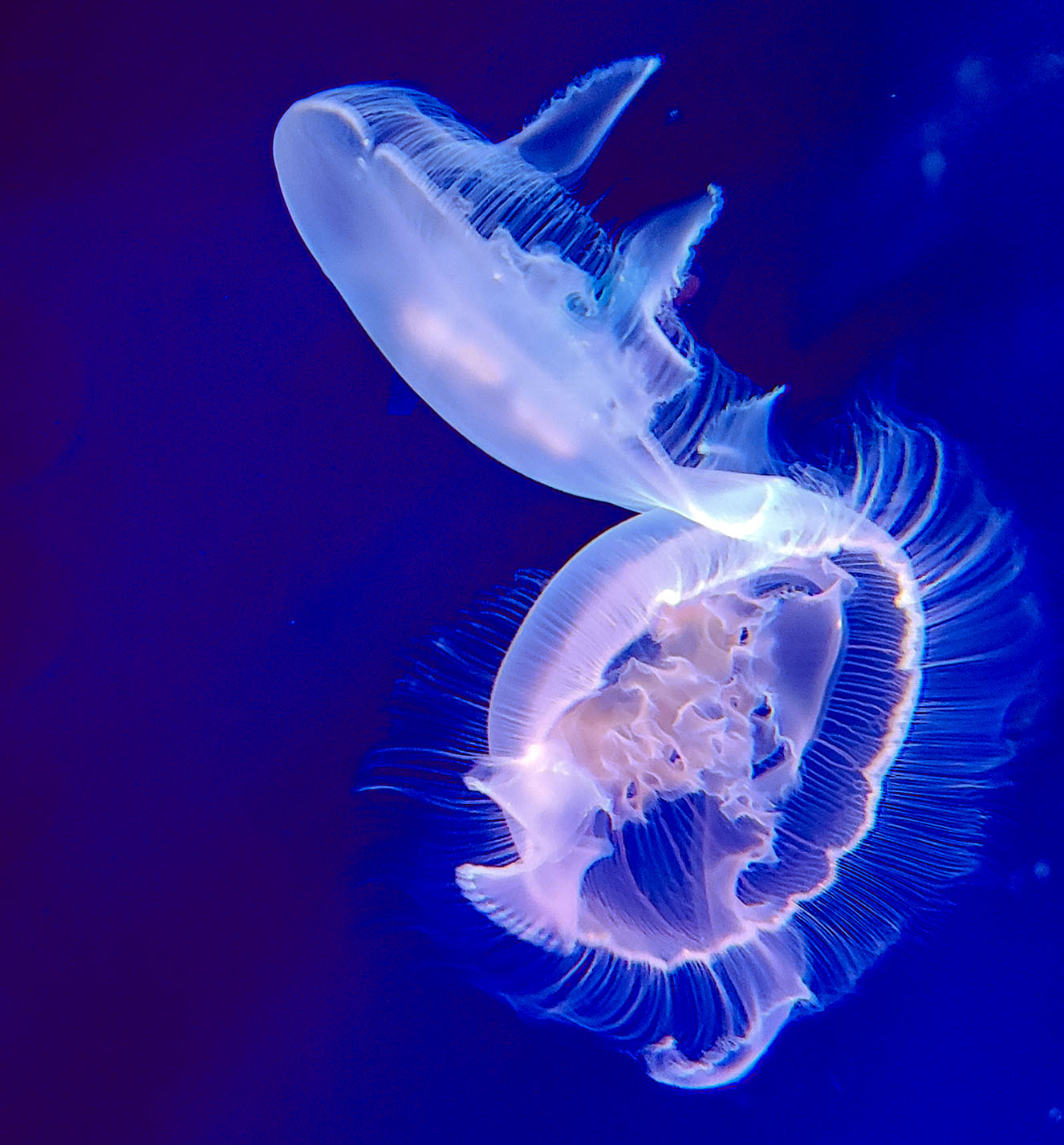
The Salish Sea is home to many jellyfish species, from tiny, translucent Sea Acorns to the large Lion’s Mane jelly that can reach 7 feet in diameter. Jellyfish use stinging barbs to ensnare their prey. Smaller species feed primarily on plankton, while larger species may also eat small fish or even other jellyfish. The most common jellyfish we spot on our travels are the Lion’s Mane, Moon, and Fried Egg jellyfish, named for its bright yellow center, like a freshly cracked egg.
BALD EAGLE
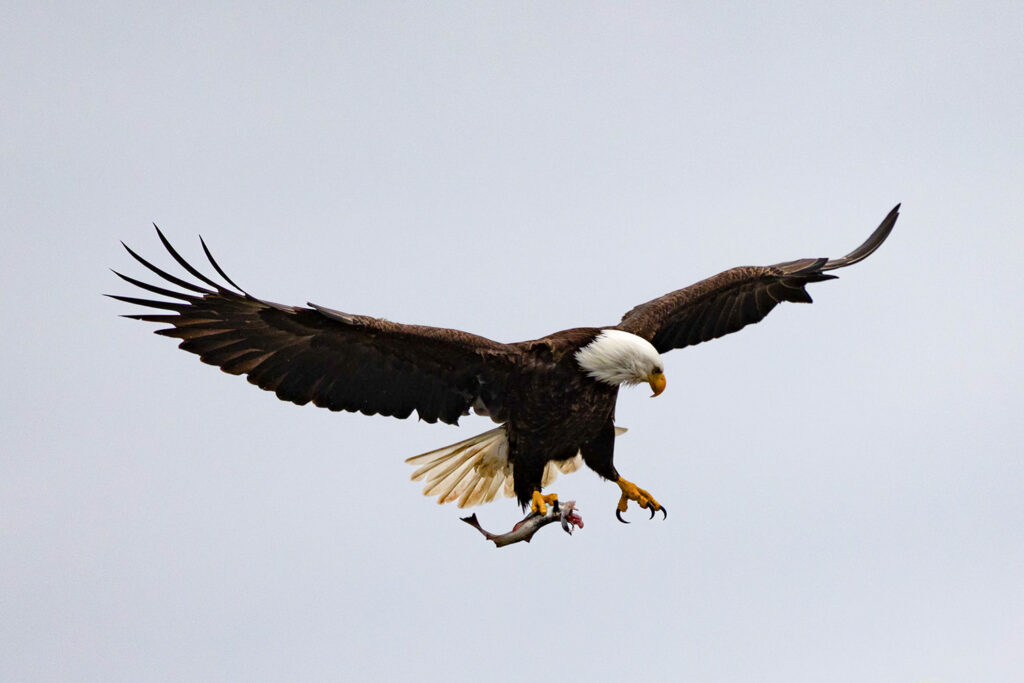
Bald eagles are large birds of prey with wingspans that can stretch over seven feet and have a weight of up to 15 pounds. Females are typically about 20 percent larger than males. They are opportunistic feeders eating anything from carrion to live fish. Eagles’ eyesight surpasses human capabilities by as much as eight times, using this ability to track fish and small mammals from the air.
Bald Eagles mate for life and return to the same nesting site each year. Adult bald eagles are dark brown with striking white heads and tails. Juvenile bald eagles are mottled brown with white patches on their chest and wings and won’t grow their white head and tail feathers until between three and five years of age. Bald eagles, once threatened by hunting and pesticides, have thrived and rebounded thanks to protective measures.
How to spot: Look for the eagle’s head appearing as a white “golf ball” against the dark foliage of trees. At low tide, eagles may be seen feeding on beaches.
OSPREY
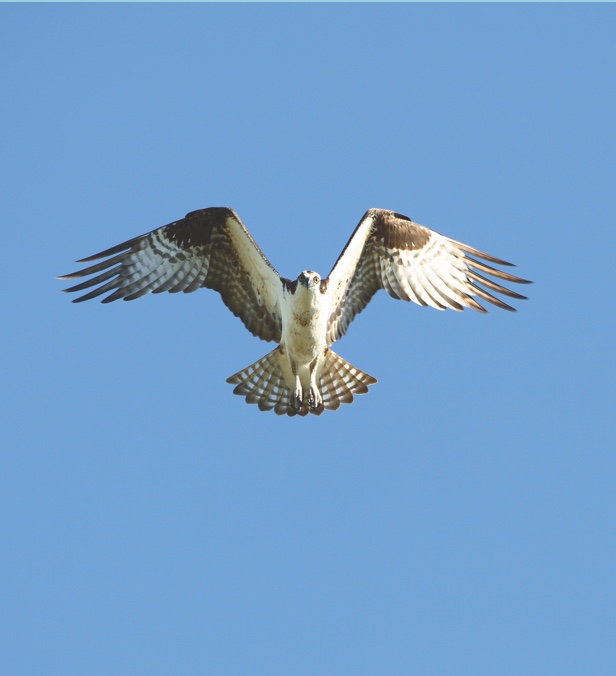
These raptors live around fresh and salt water, eating almost exclusively live fish. They can sometimes be confused with bald eagles, but are smaller, with a wingspan of five feet and weighing only about three pounds. Ospreys showcase remarkable adaptations for fishing, including reversible outer toes that facilitate a secure grip on their fish prey.
Ospreys are also known as “seahawks.”
How to spot: Look for dark brown with white on the crest of their heads and a prominent dark eye stripe.
GREAT BLUE HERON
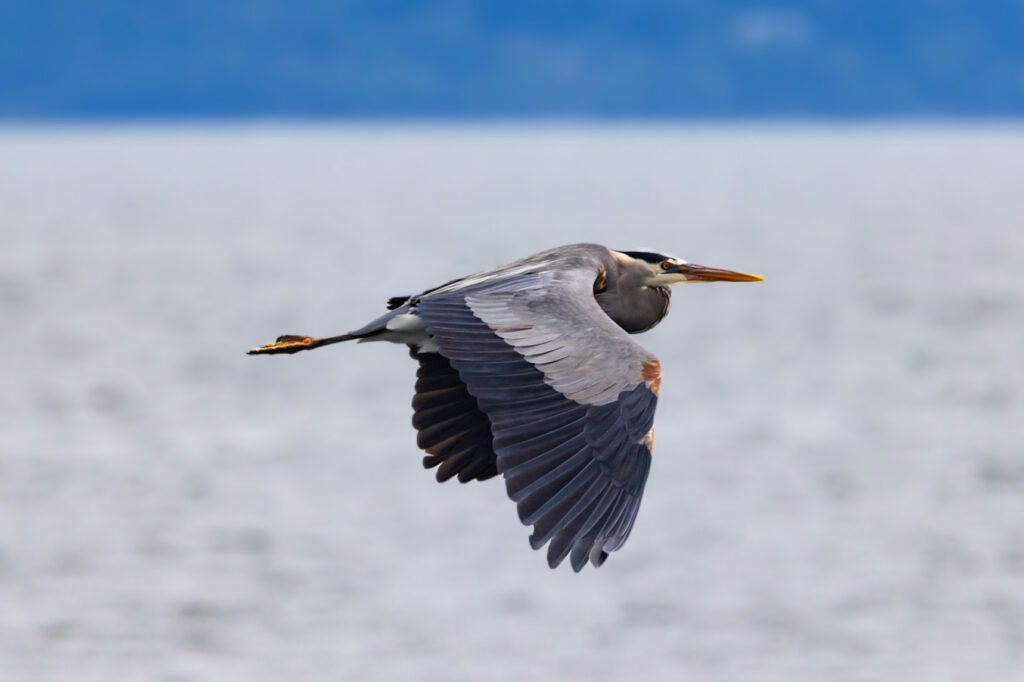
Great Blue Herons are arguably the most distinct and recognizable birds in the Pacific Northwest. Despite their large appearance, these birds are only about 5-6 pounds. They have a tall and slender build, standing around 4 feet tall, with a wingspan that can extend up to 6.6 feet. Their plumage is predominantly blue-gray, with a white face and a black stripe extending from the eye to the back of the head. A year-round resident of this region’s bays, salt marshes, and rocky coasts, these birds stalk through the shallow water on slender legs while plunging their long, sharp bills under the surface to capture fish, frogs, and other small aquatic animals.
How to spot: Look for them wading near rocky beaches, through kelp beds, and along the beach during low tides.
CORMORANT
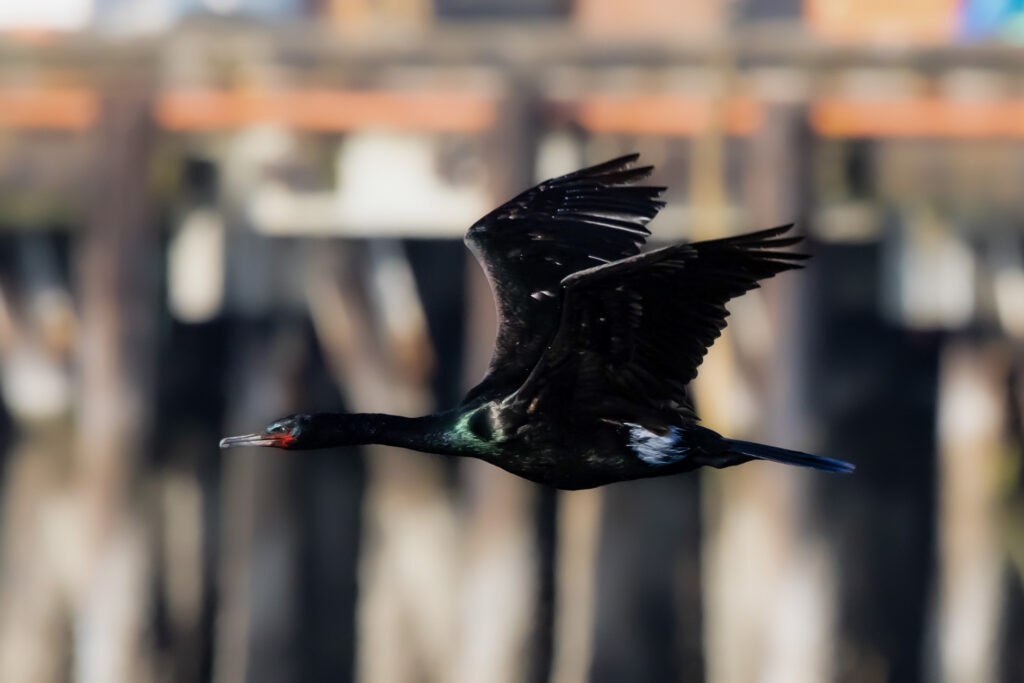
Three different species of cormorants commonly occur in the region. Cormorants are dark in color with colorful, bare facial skin, set-back legs, and long hooked bills. Unlike most water birds, cormorants do not have the same waterproofing for their feathers. This allows them to become waterlogged, capable of diving to depths of 200 feet or more to capture herring and other small marine prey.
How to spot: Look for them drying their wings on rocky outcroppings and top of buoys.
COMMON MURRE
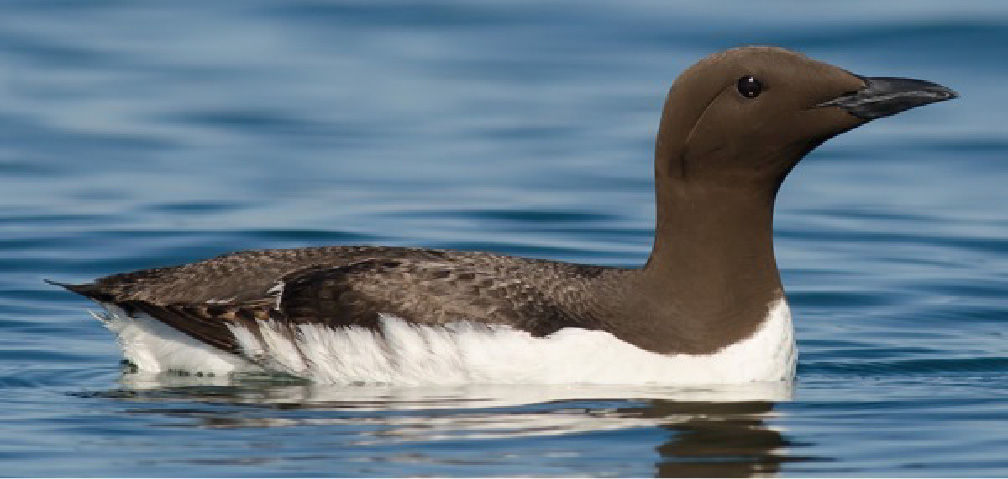
Common murres are oftentimes compared to penguins in their appearance, going so far as having a nickname of “flying penguins.” Despite this comparison, these birds are actually part of the auk and puffin family. When it comes to nesting season, adult breeding pairs will incubate a single egg with no nest on barren rocky cliffsides. To mitigate potential egg loss, they have adapted their eggs to a more elongated profile, lessening the potential for it to roll off the cliff’s edge.
How to spot: Look for a penguin-like color pattern and listen for some loud squawking!
RHINOCEROS AUKLET
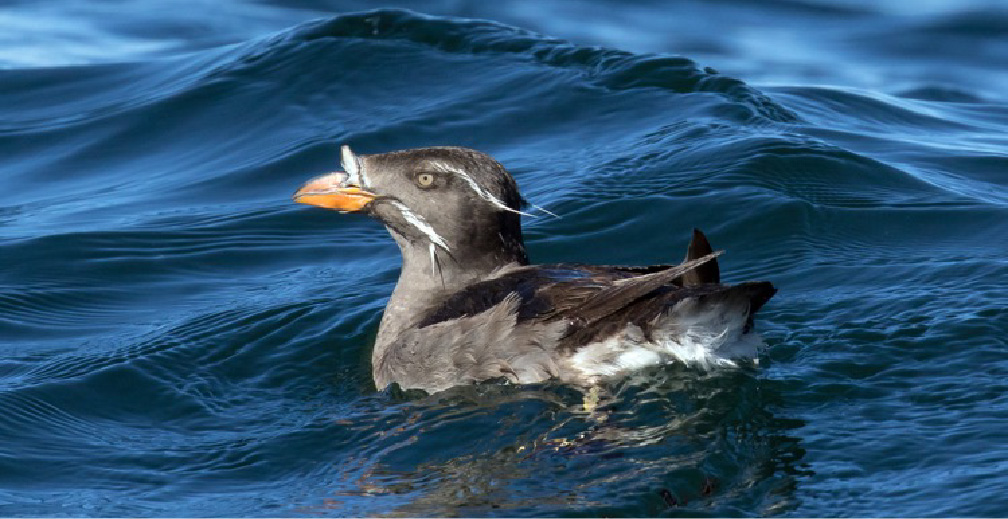
Sporting a dark plumage, these medium-sized birds feature a striking white facial plume and a unique bill with a prominent “horn” during the breeding season. Much like many of their alcid relatives, rhinoceros auklets breed in colonies on rocky islands, creating nested burrows by utilizing their robust bills and claws.
These birds will primarily supply their nest with food only at night, presumably to protect their nest from being robbed by gulls or other birds.
How to spot: Look for a dark rounded, stocky body, orange bill, and that distinctive namesake feather that resembles a rhinoceros horn.
Points of Interest
Please use this guide while referring to the map and our onboard naturalist as we cruise through the fascinating points along our waterways. The points of interest we will pass depend on where we will be traveling to search for whales.
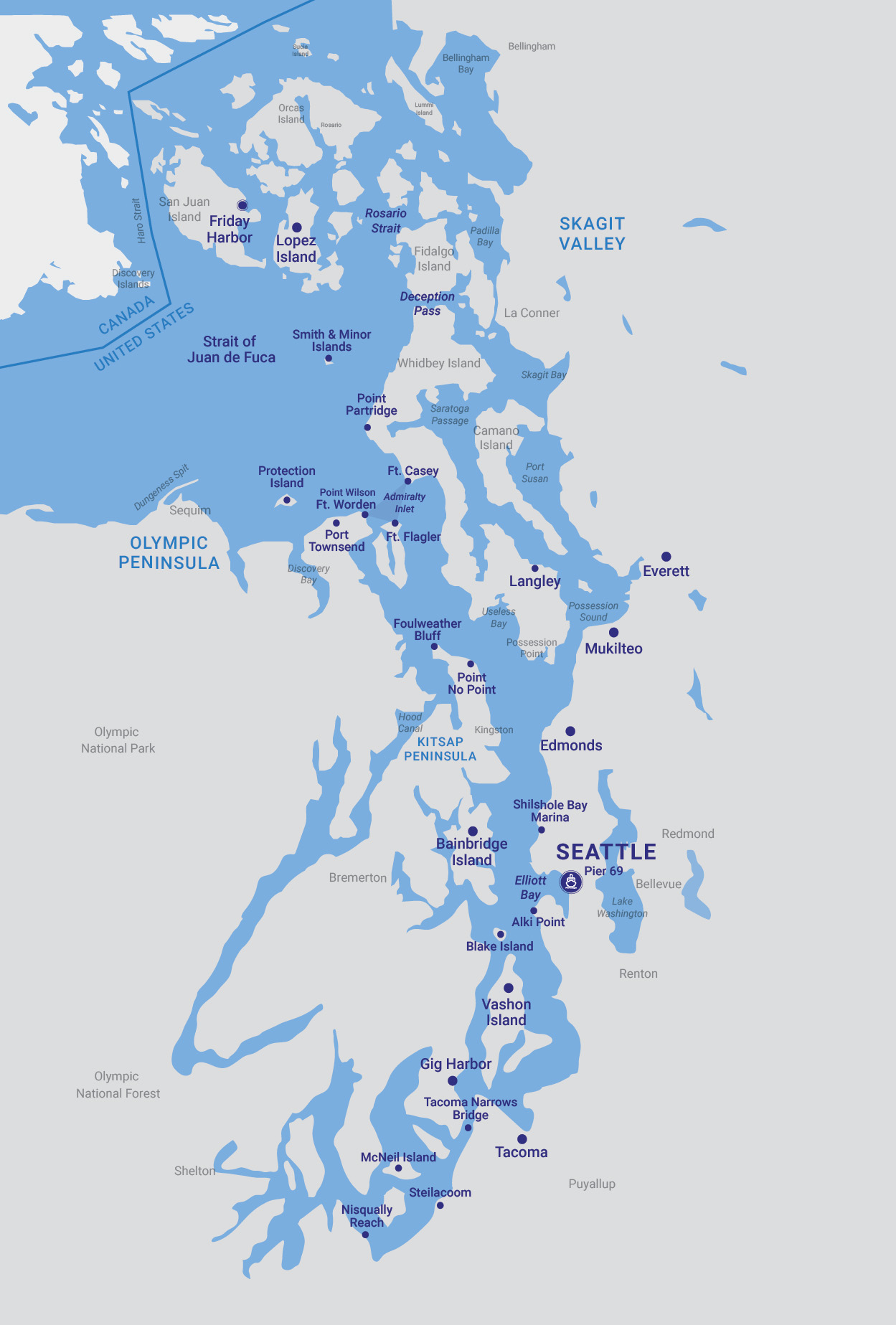
NORTH TO SOUTH
ROSARIO STRAIT forms the eastern border of the San Juan Archipelago. If the Pig War arbitration had gone against the United States, the border with Canada would have bisected at this waterway.
LOPEZ ISLAND had many names by the Coast Salish before European settlement. Its current designation was named after Gonzales Lopez de Haro, who was the first European sailor to explore the San Juans. It is the third-largest island in the San Juan Archipelago.
THE STRAIT OF JUAN DE FUCA was named for an alias the Greek mariner Apostolos Valerianos used while sailing under a Spanish flag. He sailed in search of the legendary Northwest Passage but never did sail down the promising strait. The broad 80-mile strait separates Vancouver Island from Washington’s Olympic Peninsula.
SMITH AND MINOR ISLANDS are part of a 36,000+ acre Aquatic Reserve and serve as a refuge for several of our marine species, such as nesting seabirds, summer breeding harbor seals, and even the rare sea otter.
POINT PARTRIDGE marks the westernmost point of Whidbey Island and is the location of Fort Ebey State Park.
PORT TOWNSEND was settled as a farming and fishing community and was home to the region’s customs house in 1854. Today Port Townsend is known for boutiques and bed and breakfasts that entice visitors to the town, as well as views of the Olympic Mountains, Mount Baker, Mount Rainer, and the lower Cascade Mountains on a clear day.
TRIANGLE OF FIRE – Fort Casey, Fort Worden, and Fort Flagler were built around the turn of the 20th century as part of a nationwide response to the Spanish-American War. The forts were considered obsolete shortly after they were completed due to changes in warfare tactics. Today all three are very popular state parks.
POINT WILSON AND ADMIRALTY HEAD mark the entrance to Puget Sound.
PROTECTION ISLAND was named by Captain Vancouver for the protection it affords the mainland from northerly winds. The island now protects several species of seabirds including tufted puffins and rhinoceros auklets.
DECEPTION PASS is a swift-running, narrow pass, winding through cliffs with a towering bridge connecting three islands: Whidbey, Fidalgo, and Pass Island. The pass funnels an enormous amount of water; estimated at 900 million gallons of water an hour at peak current!
LANGLEY is a late 19th-century town developed to supply cordwood to the steam-powered boats that traveled Saratoga Passage at that time. When the Great Northern Railroad completed its line to Bellingham in 1894, eliminating the need for steamers, many of Langley’s settlers departed. Today it is once again a thriving town even with a “whale bell” that is to be rang when a whale is visible from the heart of town!
EVERETT is the largest city in Snohomish County. Everett is home port to three destroyers, two frigates, and a coast guard buoy tender.
MUKILTEO is an anglicization of a Lushootseed word meaning good camping ground, and the point was a popular gathering place for local first nations prior to European contact. In 1885, Washington Governor Isaac Stevens met with over 2,000 Native Americans representing 22 different tribes, to place marks on the Point Elliot Treaty. This treaty relinquished most native claims to land in the region in exchange for allocated reservation land, some small monetary compensation, and continued harvesting rights.
FOULWEATHER BLUFF marks the northern end of the Kitsap Peninsula and the entrance to Hood Canal. Captain George Vancouver named Foulweather Bluff for the inclement weather he experienced while exploring the area in 1792.
POINT NO POINT LIGHTHOUSE is Puget Sound’s first lighthouse. The light was originally a kerosene lantern until the fifth-order Fresnel lens arrived. The radar tower spinning nearby is part of the U.S. Coast guard’s Vessel Traffic System that works with commercial marine traffic much like the air traffic control system.
EDMONDS incorporated into a town in the 1890s when its founder George Brackett added his oxen, Isaac and Bolivar, to the petition to fill out the required 72 signatures. Twenty years earlier, Brackett’s canoe was forced ashore by a storm. Impressed with the land, he bought it and built a wharf and general store.
SHILSHOLE BAY MARINA with moorage for 14,000 boats is owned by the Port of Seattle. The marina is named after an indigenous village that stood where the Hiram Chittenden Locks, locally known as the Ballard Locks, are today. The Chittenden locks are among the busiest in the country, handling more than 100,000 vessels per year, 80 percent of those being pleasure craft.
BAINBRIDGE ISLAND is named after the United States commodore William Bainbridge. His greatest victory at sea was as captain of the Constitution in the war of 1812 when it defeated the British ship Jaca. Japanese farmers settled on Bainbridge Island in the early 1900s, employing Filipino farmhands to help them tend their fields. These farmers were sent to internment camps during World War II, leaving their farmhands in charge of their property. Today descendants of these farmers and farmhands still live on the island and celebrate cultural festivals throughout the year. The island is also home to the Japanese American Exclusion Memorial.
ELLIOTT BAY is where the Duwamish River enters the Salish Sea, and salmon still travel through its deep waters on their way to spawning grounds near the base of Mount Rainier. The deep bay and protected anchorages have made it an ideal location for a major seaport. At its entrance, the bay is nearly as deep as the Space Needle is high. Towering Port of Seattle cranes line the south shore of the bay and the 395-acre Harbor Island – the secondlargest human-made island in the world. The Port property, King Street Station, and Seattle’s sports stadiums now stand on filled-in wetlands that were drained when the Cedar and White rivers were diverted away from the Duwamish riverbed and rerouted into Lake Washington and the Puyallup River, respectively.
ALKI POINT was where, in 1851, the Duwamish people welcomed the Denny Party to the shores of what became the city of Seattle. The settlers moved to the more protected location of the present Seattle downtown after spending one winter on the point. “Seattle” is an adaption of Si’ahl, the name of a chief of the Suquamish and Duwamish peoples.
BLAKE ISLAND, believed to be the birthplace of Si’ahl, is preserved as a state park only reachable by private watercraft.
VASHON ISLAND sits in the midpoint between Seattle and Tacoma. Humans have inhabited Vashon and Maury Islands for at least 12,000 years. Salish people populated the shores along both islands, where offshore waters are known for fantastic fishing.
GIG HARBOR, named after the Wilkes Expedition, got its name after the crew rowed from British Columbia and entered the harbor in a longboat called “captain’s gig.” Today Gig Harbor is an active community for tourists with shopping, dining, and recreation on every block.
TACOMA, named after the Lushootseed name for Mount Rainier, is locally known as the “City of Destiny” because the city was chosen to be the western terminus of the Northern Pacific Railroad.
TACOMA NARROWS BRIDGE is a pair of twin suspension bridges spanning the Tacoma Narrows and connecting Tacoma with the Kitsap Peninsula.
MCNEIL ISLAND, part of the original territory of the Steilacoom people, was bought by the US government in 1870 and housed a federal penitentiary. In 1981 the state of Washington acquired the penitentiary from the federal government and turned it into Washington’s Special Commitment Center.
STEILACOOM is named after the Steilacoom people. Founded in 1854, it is the oldest incorporated town in Washington.
NISQUALLY REACH is where the Nisqually River enters Puget Sound. The Billy Frank Jr. Nisqually National Wildlife Refuge protects 14,826 acres of estuarine habitat essential for salmon and many other species.
ACKNOWLEDGING THE TRADITIONAL LANDS OF THE COAST SALISH PEOPLES
Seattle resides on the traditional land of the Coast Salish Peoples, including the Duwamish, Suquamish, Tulalip, and Muckleshoot Tribes. FRS Clipper proudly and humbly acknowledges that we are on indigenous land and honors an ongoing connection to these communities past, present, and future.